You’ve been upright your whole life.
Every hour of every day, gravity has been compressing your spine, stacking vertebrae on top of discs, shortening your muscles, narrowing your joints, and slowly loading your nervous system with mechanical stress it was never designed to carry non stop.
And most people just live with the consequences. The tightness. The stiffness. The low grade ache that shows up by Wednesday afternoon. And they call it normal.
Here is what nobody is talking about.
The direction you are facing gravity matters.
And going the other way, even for a few minutes a day, does something for your body that almost nothing else does.
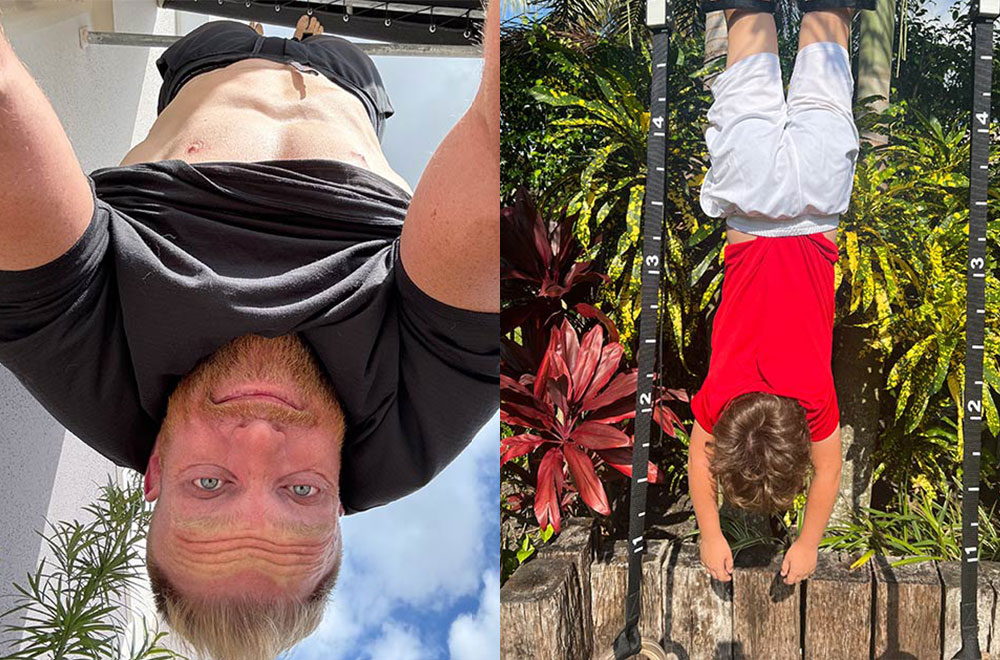
This is inversion therapy.
Hanging upside down.
And why the science behind it is deeper than most people realize.
The Real Problem in Your Spine
Before we talk about inversion, we need to talk about what is already going wrong.
In 2005, Dr. Manohar Panjabi of Yale University published a landmark paper describing how spinal dysfunction actually begins.
Not with a dramatic injury.
With subtle damage.
Microtrauma to spinal ligaments, discs, and joint capsules affects the mechanoreceptors embedded within them.
Those receptors send faulty signals.
Those faulty signals lead to poor muscle coordination.
And over time, that leads to uneven loading, inflammation, and chronic pain.
In simple terms: Your spine has a sensing system.
When it misfires, everything downstream breaks down.
And here is the key: Restricted joints do not send clean signals.
Compressed discs do not heal well.
Chronic stress turns structure into noise.
Which is why unloading the spine matters.
What Happens When You Go Upside Down
Decompression
Every time you are upright, your spine is under constant load.
- Discs compress.
- Joints narrow.
- Pressure builds.
Inversion reverses that.
It creates space between vertebrae, reduces pressure on discs and nerves, and allows the spine to decompress.
Think of your disc like a sponge.
Compressed all day, it loses fluid.
Decompress it, and it rehydrates.
That rehydration supports long term disc health, shock absorption, and nutrient flow.
Nervous System Reset
Your nervous system responds to mechanical stress.
Chronic compression feeds a low grade stress response.
- Muscles stay guarded.
- Blood flow shifts.
- The system stays alert.
Inversion interrupts that.
It shifts the body from fight or flight to rest and repair.
Research shows measurable decreases in muscle tension within seconds of inversion.
That is not placebo. That is physiology.
Circulation Boost
Compression affects circulation.
Reduced blood flow limits oxygen and healing.
Inversion flips that.
It allows gravity to assist circulation instead of fight it.
- More oxygen.
- Better tissue metabolism.
- Improved recovery.
Even the brain benefits, which is why many people report improved clarity and focus.
Tissue Elasticity
Over time, tissue stiffens.
- Scar tissue builds.
- Fascia tightens.
- Movement becomes restricted.
Inversion applies gentle traction across the body.
This helps restore elasticity.
Less like concrete.
More like a rubber band.
Lymphatic Flow
Your lymphatic system has no pump.
It relies on movement and gravity.
When you sit all day, lymph stagnates.
Inversion helps move it. It supports:
- Waste removal
- Inflammation reduction
- Immune efficiency
Combined with deeper breathing, it enhances full system recovery.
Pain Signal Reset
Pain is not just tissue damage.
It is a processed signal.
Inversion floods the system with proprioceptive input.
That input competes with pain signals.
This is known as the pain gate theory.
Better input. Less noise. More control.
Total Load Reduction
Your body carries cumulative stress.
- Physical.
- Chemical.
- Emotional.
This is called allostatic load.
Inversion reduces that load.
It gives your system a break from constant compression.
And that matters more than most people realize.
What the Research Shows
The research is not perfect.
But the signal is clear. Studies show:
- Reduced pain
- Improved function
- Lower surgery rates
In one study, only 21 percent of inversion users required surgery compared to 43 percent without it.
Another showed 75 percent improvement in pain and function after six weeks.
For a non invasive tool, that matters.
How to Get Started
You do not need to go fully upside down.
Most benefits occur at 20 to 60 degrees.
Start there. A few minutes at a time.
Stay consistent.
Like anything else, results compound.
The Bigger Picture
Your spine was designed to move.
Not to stay compressed for 16 hours a day.
Modern life does the opposite.
Sitting. Driving. Scrolling.
Inversion gives your body the opposite input.
Dr. Zev's Quick Take on Inversion Therapy
Your body adapts to what you do daily.
Gravity is constant.
Compression is constant.
But decompression can be intentional.
A few minutes a day. Done consistently.
That is how change happens.