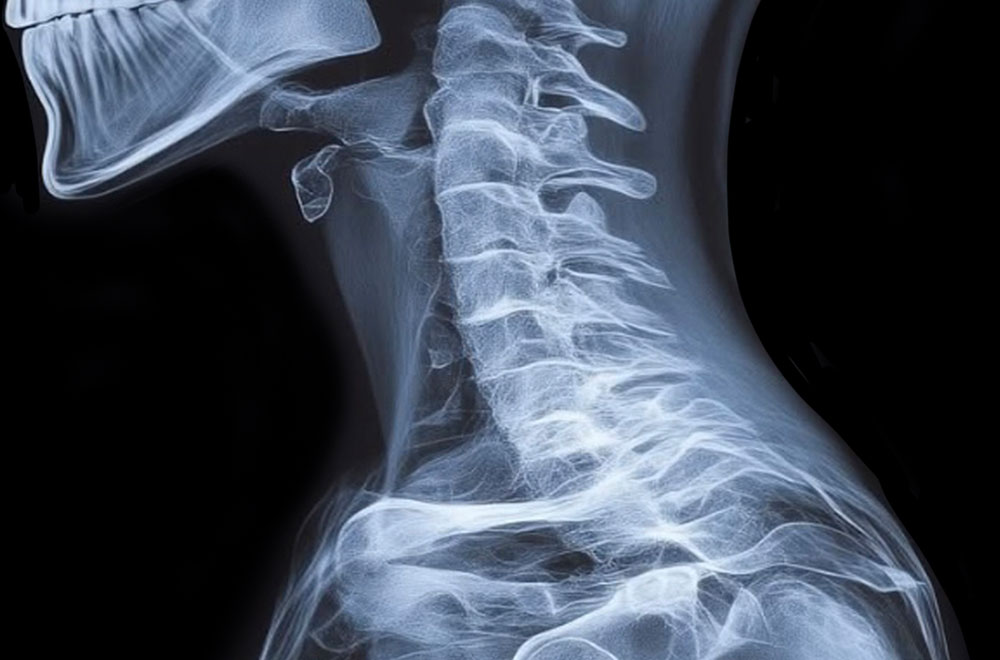
Why I X-Ray and When It's Needed
Most people think X-rays are about finding where it hurts.
They're not.
They're about finding the truth your body has been quietly hiding. Sometimes for years. Sometimes for decades.
One of the first questions I hear when I recommend X-rays is:
"Is that really necessary? I've had X-rays before and they said everything looked fine."
That response tells me two things.
First, whoever reviewed those images was probably looking for something serious. A fracture. A tumor. Something obviously broken.
They didn't find it.
So everything looked fine.
Second, nobody explained what those images were actually showing about the structure, position, and long-term health of that person's spine.
That's the gap I want to close.
Because what I look for on an X-ray has very little to do with whether something is broken. It has everything to do with how your spine is positioned, how it's loaded, and what that means for the next ten, twenty, or thirty years of your life.
An X-Ray Is a Structural Blueprint, Not a Pain Detector
Here's the most important thing to understand.
Your spine can look terrible on an X-ray and cause very little pain.
It can also look relatively normal while you're experiencing significant symptoms.
Pain is a late signal.
Structure tells a much longer story.
When I review your X-rays, I'm not hunting for pain. I'm looking at the architecture of your spine.
I'm evaluating:
- Curves
- Alignment
- Load distribution
- Joint spacing
- Bone quality
- Structural changes
I'm looking at a map.
That map tells me what kind of terrain we're working with before I ever put my hands on you.
Think about buying a house.
You don't walk in, admire the kitchen, and sign the paperwork.
You inspect the foundation first.
That's what a spinal X-ray does.
The Eight Things I Look For On Every X-Ray
When I review a full spinal X-ray series, there are eight findings I evaluate every single time.
1. Cervical Lordosis (The Curve In Your Neck)
Your neck should have a gentle forward curve. When that curve flattens or reverses, the head shifts forward. That dramatically increases the load on the structures below it. This is one of the most common findings I see. And one of the most important.
2. Forward Head Posture
Your head should sit directly over your shoulders. When it shifts forward, even slightly, the effective weight on the cervical spine increases dramatically. A head positioned just a few inches forward can create more than 40 pounds of force on the neck. Every inch matters.
3. Thoracic Kyphosis
Some upper back rounding is normal. Too much isn't. Excessive rounding limits rib cage expansion, affects breathing mechanics, and forces the neck to compensate. This is one reason so many people with upper back issues eventually develop neck problems.
4. Lumbar Lordosis
Your lower back should also have a natural curve. Too little curve increases disc pressure. Too much curve overloads the joints. Both patterns accelerate wear and tear.
5. Spondylolisthesis
This occurs when one vertebra slips forward or backward relative to another. Many people have no symptoms initially. But over time it can become a significant source of instability and nerve irritation. You cannot see it without imaging.
6. Disc Space Narrowing
Healthy discs maintain consistent height. When the space between vertebrae begins shrinking, it tells me the disc is losing hydration and structural integrity. That changes how force moves through the spine.
7. Bone Spurs and Arthritic Changes
Bone spurs don't appear randomly. They're the body's attempt to stabilize areas under chronic stress. They tell a story. And that story is usually years in the making.
8. Rotational Misalignment
X-rays often reveal subtle rotational shifts that can't be seen by looking at someone and aren't always detectable through touch. Even small rotations affect:
- Movement
- Load distribution
- Joint function
- Long-term spinal health
These details matter.
None of these findings require a fracture.
None require a tumor.
And none require severe pain.
But every one of them influences how your spine ages and functions.
The Load Numbers Most Will Never Show You
This is where things get interesting.
The average human head weighs about:
- 10 to 12 pounds in a neutral position
Move that head forward just a few inches and the load changes dramatically.
Research shows:
- 42 pounds of force with approximately 3 inches of forward head posture
- Up to 60 pounds of force in common smartphone posture
That's not a small difference.
That's a completely different environment for your spine.
Every extra pound gets absorbed by:
- Discs
- Ligaments
- Joints
- Muscles
And it happens every day.
Over years, those loads leave evidence.
The flattened neck curve.
The narrowed disc.
The bone spur at C5-C6.
The image is the receipt.
This is the exact pattern we discussed in our article on Tech Neck and Forward Head Posture.
Why Structure and Neurology Are The Same Conversation
This is the part most people never hear.
Your spinal joints are not just mechanical structures.
They're neurological structures.
Embedded throughout your discs and joints are sensory receptors called mechanoreceptors.
Their job is to constantly report information to your brain about:
- Position
- Motion
- Pressure
- Tension
- Alignment
When your spine moves properly, those signals are accurate.
The brain receives clean information.
The body responds appropriately.
When the spine becomes dysfunctional, those signals become distorted.
The brain receives bad information.
And bad information creates bad output.
That can show up as:
- Poor muscle coordination
- Chronic tension
- Altered pain processing
- Reduced movement efficiency
This concept sits at the root of the question: "What Is Chiropractic Care?
Because chiropractic isn't simply about joints.
It's about improving the quality of information flowing between the body and the brain.
Can Any Of This Actually Change?
Yes, it can.
And this is where the research becomes exciting.
Corrective chiropractic approaches use objective measurements to track changes in spinal structure over time.
The goal isn't simply symptom management.
The goal is measurable improvement.
Research has demonstrated improvements in:
- Cervical curvature
- Postural alignment
- Structural positioning
- Long-term spinal mechanics
That doesn't mean every spine becomes perfect.
And it doesn't happen overnight.
But meaningful change is possible.
I see it every week in my chiropractic office.
Not because of magic.
Because the body adapts to the input it receives.
What Happens After We Review Your X-Rays Together
When I sit down with a patient, I'm not reading a list of problems. I'm telling a story. The story of how their spine got where it is today.
Years of posture habits. Old injuries. Work demands. Movement patterns. The loads the body adapted to.
Then we build a plan. Not a generic protocol. Not the same chiropractic adjustment for everyone. A plan based on what the X-rays actually show. Many conditions, including Sciatica, make much more sense once you can see what's happening structurally.
The X-ray isn't the scary part. The X-ray is the starting point. It's the first honest conversation between you and your spine.
Frequently Asked Questions
Final Thought
Your spine has been keeping score this entire time.
Every posture. Every habit. Every hour at a desk. Every year of adaptation.
The X-ray is simply the moment you finally get to see the scoreboard.
Most people don't leave that conversation feeling scared.
They leave feeling relieved.
Because now they understand what they're looking at.
And more importantly, they understand what can be done about it.
About the Author:
Dr. Zev Mellman is a licensed chiropractor serving patients throughout South Florida and beyond. His practice focuses on spinal health, mechanical causes of pain, and conservative approaches to musculoskeletal care.
- Licensed Doctor of Chiropractic in the State of Florida
- Florida License Number: CH9524
- License Original Issue Date: 01/15/2008