"I Thought I Just Pulled a Muscle."
One of the most common things I hear from new patients is:
"I figured I just pulled something."
Maybe it happened while unloading groceries.
Maybe it started after a workout.
Maybe you bent over to pick up your child and suddenly felt a sharp pain shoot through your lower back.
For some people, that's where the story ends.
For others, the pain begins traveling down the leg.
Their foot starts tingling.
Their toes become numb.
Sitting becomes miserable.
Sleeping becomes difficult.
Now they're wondering if they have a herniated disc.
Sometimes they do.
Sometimes they don't.
One of the biggest misconceptions about back pain is that every painful episode is caused by a herniated disc. In reality, there are many different structures in the spine capable of producing pain. The only way to understand what's truly happening is through a thorough examination and, when appropriate, diagnostic imaging.
That's why I never like guessing.
I prefer understanding.
If you've been struggling with ongoing back or neck pain and are looking for a chiropractor in Davie, the first step is identifying the true source of your symptoms instead of simply treating the pain.
What Is a Herniated Disc?
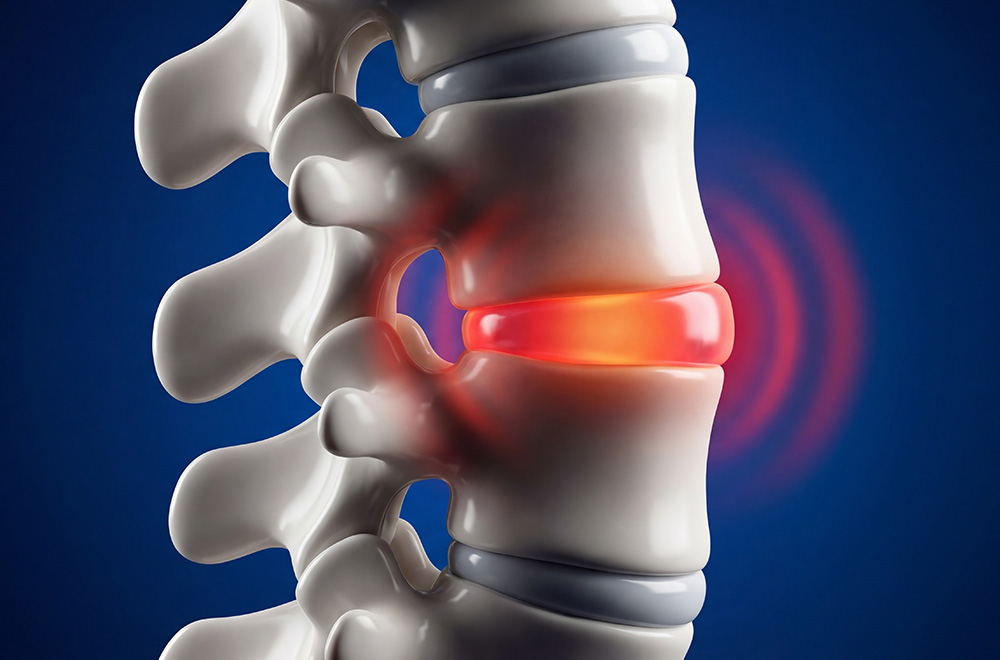
A herniated disc occurs when the tough outer layer of a spinal disc develops a tear or weakness, allowing part of the soft inner material to push outward.
Think of a spinal disc like a jelly-filled doughnut.
The outside is made of strong fibers that help contain the softer center.
Over time, injury, repetitive stress, or age-related changes can weaken those outer fibers. When enough pressure builds, the inner material can begin pushing through the damaged area.
Sometimes that material presses against a nearby nerve.
Sometimes it doesn't.
That's an important distinction because not every herniated disc causes symptoms.
In fact, many people have disc herniations and never know it.
Others experience significant pain because the herniation irritates or compresses a nerve root.
The location of the herniation often determines where symptoms are felt.
A herniated disc in the lower back may produce pain, numbness, tingling, or weakness that travels into the buttock, leg, or foot.
A herniated disc in the neck may cause similar symptoms into the shoulder, arm, or hand.
A Herniated Disc Is Not the Same as a Bulging Disc
Patients often use these terms interchangeably.
They're actually different.
A bulging disc occurs when the disc extends beyond its normal boundaries but the outer layer remains intact.
A herniated disc means the outer fibers have been compromised, allowing disc material to push farther outward.
Both conditions can produce symptoms.
Both can also exist without causing any pain.
That's one reason I caution patients against assuming that an MRI finding automatically explains their symptoms.
I've seen patients with significant disc changes who have very little pain.
I've also seen patients with relatively small disc injuries who are extremely uncomfortable.
Your imaging should always be interpreted alongside your history and physical examination.
What Causes a Herniated Disc?
Many people expect a dramatic injury to be responsible.
Sometimes that's true.
More often, it isn't.
A herniated disc usually develops over time.
Years of repetitive stress, decreased spinal mobility, poor lifting mechanics, previous injuries, prolonged sitting, and natural age-related changes can gradually weaken the disc.
Eventually, one seemingly minor movement becomes the event everyone remembers.
They bent over.
They sneezed.
They reached into the back seat.
They picked up a laundry basket.
The movement gets blamed.
In reality, the disc had probably been under increasing stress long before that moment.
That's one reason I encourage patients not to focus solely on what they were doing when the pain started.
Instead, I want to understand everything that led up to it.
Common Symptoms of a Herniated Disc
Symptoms vary depending on where the disc is located and whether a nerve is involved.
Common symptoms include:
- Lower back or neck pain
- Pain that radiates into an arm or leg
- Numbness or tingling
- Muscle weakness
- Burning or electric-like pain
- Pain that worsens with coughing or sneezing
- Difficulty sitting for long periods
Many patients describe the pain as shooting, burning, or sharp.
Others simply notice that one leg doesn't feel as strong as it used to.
If symptoms begin traveling below the knee, there's a greater possibility that nerve irritation is involved. In many cases, that pain is referred to as sciatica, although sciatica itself is a symptom rather than a diagnosis. I cover that distinction in more detail in What Is Sciatica? And Why Most People Treat It Wrong.
Does Every Herniated Disc Require Surgery?
Fortunately, no.
One of the biggest fears patients have after hearing the words "herniated disc" is that surgery is inevitable.
Fortunately, that's rarely the case.
Many people improve with conservative care.
The appropriate treatment depends on several factors, including the size and location of the herniation, the severity of symptoms, neurological findings, and how long the problem has been present.
My first priority is determining whether you're someone who is appropriate for conservative treatment or whether your symptoms require immediate medical referral.
Fortunately, most patients fall into the first category.
That doesn't mean ignoring the problem.
It means developing a plan designed to improve spinal function while carefully monitoring your progress.
Why an Accurate Diagnosis Matters
One of the reasons I spend so much time evaluating new patients is because similar symptoms can have very different causes.
A muscle strain.
A restricted spinal joint.
Sciatica.
A herniated disc.
Spinal arthritis.
Each one requires a different conversation.
That's why I don't believe in guessing based solely on symptoms.
Your history matters. Your examination matters. When appropriate, imaging matters. If you're wondering why imaging is sometimes recommended and other times it isn't, I explain exactly why chiropractors take X-rays and how they help us understand spinal structure instead of simply chasing symptoms.
The more accurately we identify the source of your symptoms, the more confidently we can discuss your treatment options and your long-term prognosis.
Sometimes a herniated disc is the primary problem.
Sometimes it's simply one piece of a much larger picture involving how your spine has been functioning for years.
Either way, understanding the diagnosis is the first step toward making informed decisions about your health.
Can a Herniated Disc Heal on Its Own?
One of the most encouraging conversations I have with patients is explaining that a herniated disc does not automatically mean permanent damage.
In many cases, the body has an incredible ability to adapt and heal. The inflammation around the injured disc can decrease, irritated nerves may calm down, and over time, the body can even begin breaking down and absorbing some of the herniated disc material. As that process occurs, many people notice their pain gradually becomes less frequent and less intense.
That doesn't mean every herniated disc completely disappears, and it doesn't mean symptoms should simply be ignored while waiting for the body to heal. Continuing to move poorly, avoiding all activity, or pushing through significant pain can prolong recovery.
The goal of conservative treatment is to create an environment where healing can occur while helping restore normal movement, reduce stress on the injured tissues, and improve overall spinal function.
Every patient's recovery timeline is different. Some people improve within a few weeks, while others require several months of consistent care. Factors such as age, activity level, overall health, and the severity of the disc injury all influence recovery.
The important takeaway is this: a herniated disc diagnosis is not the end of the story. Many patients recover without surgery and return to doing the activities they enjoy.
Conservative Treatment Options
When someone is diagnosed with a herniated disc, the first question is often, "What's the fastest way to make this go away?"
Unfortunately, there isn't a magic fix.
There is, however, a thoughtful approach that focuses on reducing irritation, restoring normal movement, and allowing your body to heal.
Some patients are prescribed medications while trying to manage the pain from a herniated disc. Medication may have a role in certain situations, but it's important to understand both the potential benefits and limitations. If you've been prescribed gabapentin, I recommend reading Gabapentin for Back Pain: What Patients Should Know before deciding whether it's the right fit for your situation.
Depending on your examination findings, conservative treatment may include:
Chiropractic Care
Gentle chiropractic adjustments may help restore motion to spinal joints that have become restricted. Improving overall spinal mechanics can reduce unnecessary stress placed on surrounding muscles and joints.
Not every patient with a herniated disc is an appropriate candidate for the same type of adjustment. That's why treatment should always be individualized after a thorough examination.
Spinal Decompression
For some patients, spinal decompression therapy may be recommended.
This specialized form of traction is designed to gradually reduce pressure within the spinal discs. While it isn't appropriate for everyone, certain patients with disc-related conditions may benefit as part of a comprehensive treatment plan.
Soft Tissue Therapy
Muscles surrounding an injured disc often become tight and protective.
Addressing those muscular restrictions can improve comfort and help restore more normal movement patterns.
Therapeutic Exercise
One of the most important parts of recovery happens outside the office.
Specific stretching and strengthening exercises help improve spinal stability, restore mobility, and reduce the likelihood of future flare-ups.
Patients who actively participate in their recovery often experience better long-term outcomes than those who rely solely on passive treatment.
Lifestyle Modifications
Simple daily habits can make a significant difference.
Improving lifting mechanics, reducing prolonged sitting, maintaining a healthy weight, staying physically active, and strengthening your core all help reduce unnecessary stress on your spine.
Recovery doesn't stop when you leave the treatment room.
When Is Surgery Necessary?
Although surgery receives a great deal of attention, it's only necessary for a relatively small percentage of patients with herniated discs.
There are situations where surgery becomes the most appropriate option, particularly when someone experiences progressive muscle weakness, significant loss of function, or certain neurological emergencies.
For example, severe bowel or bladder dysfunction combined with numbness in the groin area requires immediate medical attention. Fortunately, these situations are uncommon, but they should never be ignored.
More commonly, surgery may be considered if severe pain persists despite an appropriate course of conservative treatment or if neurological symptoms continue to worsen.
One thing I always remind patients is that surgery should never be chosen out of fear alone.
It should be based on a careful evaluation of your symptoms, physical examination, imaging findings, and overall quality of life.
My responsibility is to recognize when conservative care is appropriate and when referral to another specialist is in your best interest.
Build Capacity Instead of Chasing Pain
One concept I frequently discuss with patients is the difference between demand and capacity.
Demand is everything you ask your body to do.
Working.
Playing golf.
Lifting your children.
Gardening.
Traveling.
Exercising.
Those demands aren't going away, and most people don't want them to.
Capacity is your body's ability to handle those demands.
A healthy spine with good mobility, stable joints, and proper movement patterns has greater capacity than one that's stiff, degenerating, or compensating.
When demand exceeds capacity, the body begins breaking down.
That's when flare-ups happen.
The goal shouldn't be to avoid activity forever.
The goal is to build a spine that can handle the life you want to live.
For some patients, that means chiropractic adjustments to restore motion.
For others, it may also include spinal decompression therapy when disc involvement is contributing to their symptoms.
Regardless of the treatment plan, the objective remains the same.
Increase your body's capacity so everyday life no longer overwhelms your spine.
Frequently Asked Questions
Conclusion
A herniated disc diagnosis can sound intimidating, but it doesn't automatically mean surgery or lifelong pain.
Many people recover successfully with conservative treatment, especially when the problem is identified early and managed appropriately.
The first step is understanding what's actually causing your symptoms.
That's why every patient begins with a thorough examination, not assumptions.
If you're experiencing back pain, neck pain, numbness, tingling, or pain traveling into your arms or legs, I'd be happy to evaluate your condition and discuss the treatment options that are most appropriate for you. If you're considering becoming a patient, you can also read what to expect at your first chiropractic visit before scheduling your appointment.