
If you live in Broward County but work in Miami, you already know what the commute can look like.
You leave your house and spend a good portion of your morning in a seated position, driving to your office down south. Then you arrive at work. And what do you do? You sit down again.
You may spend the next eight or nine hours working at a computer, sitting through meetings, answering emails, looking at multiple monitors, or working from a laptop. Then it's time to go home. Back in the car.
This is a pattern I see all the time with patients in South Florida.
The problem isn't just that you're sitting.
It's the amount of time your body spends in that same position, the repetitive nature of your day, and how little movement may occur between those long periods of sitting. Eventually, your neck feels tight. Your lower back starts aching.
You find yourself shifting around in the driver's seat trying to get comfortable. Headaches may start showing up at the end of the workday. And many people assume this is just part of having a demanding career and a long commute. It doesn't have to be.
The Miami Corporate Lifestyle Can Be Tough on Your Spine
South Florida has a unique work environment. A large number of professionals live in Broward County while working farther south in Miami, Brickell, Downtown Miami, or surrounding business districts.
That creates a lifestyle where your workday doesn't begin when you arrive at the office. It begins when you get into the car. Think about the amount of time involved. You might spend an hour driving to work. Then eight hours primarily sitting. Then another hour driving home.
That's roughly ten hours of your day where your body has relatively little opportunity to move normally. And if you get home exhausted, eat dinner, sit on the couch, or answer a few more emails on your laptop, the cycle continues. That's why I don't look at someone's neck or back pain only in terms of what happened yesterday. I want to know what their body has been doing repeatedly for months or years.

Why Driving Can Aggravate Lower Back Pain
There's a reason why driving and lower back discomfort frequently seem to go together. When you're behind the wheel, your body is essentially locked into a relatively constrained position. Your feet are occupied with the pedals, your hands are on the steering wheel, your hips remain flexed, and your lower back is supported, or sometimes poorly supported, by the seat. Unlike sitting at home, you can't simply get up and move around whenever you begin to feel stiff.
Research involving professional drivers consistently shows that lower back pain is common among people who spend substantial amounts of time behind the wheel. Studies have identified prolonged sitting, vehicle ergonomics, uncomfortable seating, limited back support, work duration, and driving posture as potentially important contributors.
That doesn't mean scientists can point to one exact driving position and say, "This posture causes back pain." The research isn't that simple, and your body isn't that simple either. What matters clinically is the bigger picture: how much time you're spending in constrained positions, how well your spine is moving, what happens during the rest of your day, and whether your body has the capacity to tolerate those demands.
Your Commute Isn't Happening in Isolation
This is the part people often miss. If you drove for an hour and then spent the rest of the day moving, walking, lifting, and regularly changing positions, your body would experience something very different. But that's not what the typical day looks like for many corporate professionals. Instead, the commute often leads directly into another long period of sitting.
Your day may look something like this:
Drive → desk → meeting → desk → lunch → desk → meeting → drive
Your spine doesn't know that some of those hours were spent in a BMW on I-95 while others were spent in an expensive ergonomic chair in Brickell. It simply responds to the physical demands being placed on it throughout the day.
That's why buying a better office chair doesn't necessarily solve the problem. A supportive chair may help. Adjusting your car seat may help. Improving your monitor position may help. But none of those things replaces the need to move your body and regularly change positions throughout the day.
Why Your Neck Gets Tight During a Long Commute
Your lower back isn't the only area affected. Think about what happens to your neck when you drive. You're watching traffic ahead, checking your mirrors, looking over your shoulder, glancing at navigation, and sitting with your arms extended toward the steering wheel. If you're stuck in traffic, you're maintaining many of those positions for an extended period.
Now add the workday. You arrive at the office and start looking at a monitor, then your phone, another monitor, your laptop, and eventually back to your phone again. By the time you drive home, your neck and shoulders may already feel tight before you even start the car.
That desk portion of the workday matters too, especially if sitting at a desk all day consistently leaves your neck and shoulders tight.
I discuss the screen-related side of this problem in Tech Neck Is Not a Posture Problem. It's Structural. One of the mistakes people make is assuming the answer is simply to force themselves to "sit straight." Posture matters, but posture isn't just about whether you look upright. It's also about how your body adapts to what you repeatedly ask it to do.
Why Your Back May Hurt More on the Drive Home
I've had patients tell me something that sounds strange at first: "My drive to work isn't that bad. It's the drive home that kills me." But when you think about what their body has been doing all day, it actually makes sense.
Your morning commute happens after you've been lying down overnight and moving around while getting ready for work. The evening commute is different. By then, you've already gone through an entire workday. If your spine has spent hours in relatively static positions, getting back into the car can expose stiffness and discomfort that has accumulated throughout the day.
This is also why pain isn't always a reliable indicator of when a problem actually began. I've written before about why lower back pain keeps coming back. People often focus on the exact moment their back started hurting. Maybe they bent over, picked something up, got out of the car, played golf, or worked out.
But the activity that finally triggered the pain may not tell us the entire story. Sometimes it's simply the point when your body could no longer compensate as effectively as it had before.
"But I Work Out. How Can Sitting Be the Problem?"
This is especially important for the type of patients I see here in South Florida. You can be very active and still have problems related to how you're spending the rest of your day. You might lift weights five days a week, play golf every weekend, run, cycle, play pickleball, or train Jiu-Jitsu. None of that automatically erases eight or ten hours of repetitive positioning during the workday.
In fact, this is where some active people become frustrated. They think, "I'm in good shape. Why does my back hurt?" The answer is that fitness and spinal function aren't exactly the same thing. You can be strong and still have areas that aren't moving properly. You can have excellent cardiovascular conditioning and still experience neck stiffness. You can look and feel fit in many ways while still dealing with recurring lower back pain.
Exercise is extremely valuable, but it doesn't make you immune to the physical demands of your occupation and commute. What you do in the gym or on the weekend matters, but so does what you're asking your body to do during the other hours of your day.
Your Car Setup Still Matters
I don't want the message here to become, "Posture doesn't matter, so sit however you want." That's not what I'm saying. Your driving setup absolutely deserves attention, especially if you spend a significant amount of time in the car. Start with the basics.
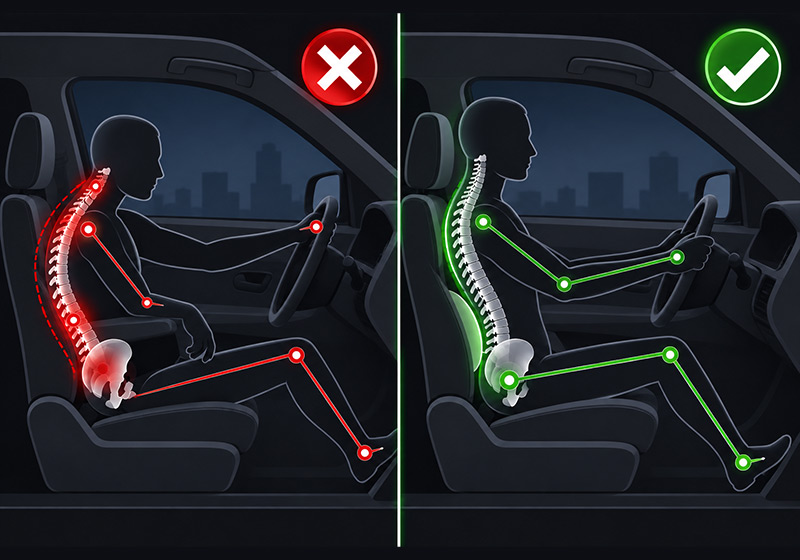
1
Don't Sit Too Far From the Steering Wheel
If you have to reach significantly forward to hold the wheel, your shoulders and upper back may remain under unnecessary tension.
Move close enough that your elbows can stay comfortably bent while maintaining safe control of the vehicle.
2
Pay Attention to Your Seatback
A seat that's dramatically reclined can encourage you to reach forward with your head and shoulders.
On the other hand, sitting rigidly upright because someone told you that "90 degrees is perfect posture" isn't necessarily the answer either.
You want a position that feels supported and allows you to operate the vehicle comfortably.
3
Use the Lumbar Support Intelligently
Many modern vehicles have adjustable lumbar support.
Use enough to comfortably support your lower back without feeling like the seat is forcing your spine into an exaggerated position.
More support isn't automatically better.
4
Empty Your Back Pocket
This is a simple one.
If you carry a thick wallet in your back pocket, take it out before a long drive.
Sitting unevenly for an extended period isn't helping anything.
5
Adjust Your Mirrors After You Adjust Your Seat
Set your seat first.
Then set your mirrors.
You shouldn't have to repeatedly crane your neck or move your entire body just to see properly.
These adjustments aren't a treatment for an underlying spinal problem, but they can make your daily environment more tolerable.
The Most Important Adjustment May Be Getting Out of the Car
If your schedule allows it, movement breaks are one of the simplest things you can do. You don't need an elaborate stretching routine or a complicated series of exercises. When you have the opportunity, get out of the car, walk around, move your hips and shoulders, and let your spine experience positions other than the one it has maintained for the last hour.
The same principle applies once you arrive at work. Don't think that because you survived the commute, you're finished sitting. For many professionals, that's when the second half of the problem begins. Stand during a phone call, walk to someone's office instead of messaging them, get up between meetings, change positions throughout the day, or take a short walk at lunch.
The goal isn't to discover one perfect posture and somehow maintain it for eight hours. The goal is to stop asking your body to remain in the same position all day.
When Neck or Back Pain Keeps Returning
Occasional stiffness after an unusually long drive is one thing. A recurring pattern is different. If every commute leaves your neck tight, your lower back hurts every afternoon, or you're constantly stretching and changing positions just to feel normal, I wouldn't ignore that pattern.
The same applies if you're taking medication simply to get through the workweek, or if your pain improves over the weekend only to return as soon as your normal work and commuting routine begins again. When the same symptoms keep showing up under the same circumstances, your body is telling you something.
The mistake is assuming that the pain itself is the entire problem. Pain is often the alarm. My job is to figure out why that alarm keeps going off.
How I Evaluate Commuters With Neck and Back Pain
When someone comes into my Davie office with recurring neck or lower back pain, I don't automatically assume their commute is the cause. I start by evaluating the person and understanding their history. Where is the pain? When did it begin? What makes it better or worse? Does the pain travel? Are there any neurological symptoms?
I also want to understand what their typical day looks like. How much time do they spend driving? What happens after they get out of the car? Are they sitting at a desk for most of the day? What does their activity level look like after work and on weekends? All of that gives me a better picture of the physical demands being placed on their body.
From there, I examine how the spine is actually functioning. When appropriate, X-rays may provide additional information about spinal structure, alignment, degeneration, and other factors that can't be determined simply by looking at someone sitting in a chair. That's why I've written extensively about why chiropractors take X-rays.
The goal isn't to blame everything on your commute. It's to understand whether the demands of your commute and workday are repeatedly exposing an underlying problem.
Working in Miami Doesn't Mean Your Healthcare Needs to Be There
This is something I want more South Florida professionals to think about. You may work in Brickell, Downtown Miami, or somewhere else in Miami-Dade, but that doesn't necessarily mean you want to schedule another appointment near the office. That can mean dealing with more traffic, finding parking, and then still having to make the commute home afterward.
If you're looking for a chiropractor in Davie, my office is conveniently located for patients who live throughout the surrounding Broward County area, including many whose careers take them throughout South Florida.
Where you work and where you receive healthcare don't have to be in the same place.
Don't Let Your Commute Become Your Excuse
Busy professionals are good at adapting. That's part of what makes them successful. Your neck gets tight, so you stretch it. Your back hurts, so you change chairs or buy lumbar support for the car. Maybe you start standing at your desk, take ibuprofen, get a massage, or try something else that provides temporary relief. Then you tell yourself you'll deal with it when work slows down, and before you know it, six months have gone by.
My advice is simple: if something keeps coming back, stop asking only how to make it feel better today and start asking why it keeps happening. If your Miami commute and workday consistently leave you with neck pain, back pain, headaches, stiffness, or other symptoms, let's figure out what's actually going on.
You don't need to quit your job or move closer to Brickell, and you certainly don't need to accept feeling terrible every time you get out of the car. You may simply need to start paying attention to what your body has been trying to tell you.
Frequently Asked Questions
A long commute can absolutely contribute to a pattern of lower back pain, especially when driving is combined with an otherwise sedentary workday. You're spending an extended period in a relatively fixed position, then often getting out of the car and sitting at a desk for several more hours.
That doesn't mean driving automatically "causes" every case of lower back pain. I don't like making that assumption because two people can have nearly identical commutes and experience completely different symptoms.
What matters is how your spine is functioning, how much movement you're getting throughout the day, your previous injuries, your physical condition, your work environment, and how your body is responding to those demands.
If your lower back consistently hurts during or after your commute, particularly if the problem keeps returning, that's a pattern worth investigating rather than simply blaming it on traffic or getting older.
Driving and sitting at a desk aren't exactly the same.
When you're driving, your feet and legs are involved with the pedals, your hands are controlling the vehicle, and you're restricted by the seat, steering wheel, and surrounding space. You also can't simply stand up when your back begins feeling stiff.
Then there is time.
If you've already spent eight hours working before getting into your car, the drive home may be when you finally notice how stiff or uncomfortable you've become.
That's why I want to understand a patient's entire day rather than focusing only on the driver's seat.
Your commute may be aggravating the problem, but we still need to determine why your lower back is having difficulty tolerating that position in the first place.
There isn't one magical driving position that guarantees you won't develop back pain.
I recommend starting with comfort, support, and avoiding unnecessary reaching.
Your seat should allow you to comfortably reach the steering wheel with some bend in your elbows. Your pedals should be accessible without stretching your legs excessively. Use your vehicle's lumbar support if it feels comfortable, but don't assume that more lumbar support is always better.
You should also be able to see your mirrors without repeatedly straining your neck.
Most importantly, remember that even a beautifully adjusted driver's seat is still a driver's seat.
If you're spending significant amounts of time behind the wheel, changing positions and getting out to move when practical can be just as important as obsessing over finding "perfect posture."
Driving requires your neck and upper body to remain relatively controlled for long periods.
You're watching the road, checking mirrors, looking at traffic, turning your head, using navigation, and holding your arms toward the steering wheel.
Now combine that with what many professionals do after arriving at work: computers, laptops, phones, meetings, and more sitting.
By the afternoon, your neck may have been dealing with those repetitive demands for hours before you even begin your drive home.
That's why I wouldn't necessarily look at the commute as an isolated problem. I want to know what's happening during the other eight or ten hours of your day as well.
If neck pain repeatedly accompanies your commute, particularly when it's combined with headaches, arm symptoms, weakness, numbness, or tingling, it deserves a proper evaluation.
A lumbar support can make driving more comfortable for some people.
Many newer vehicles already include adjustable lumbar support, and a small cushion can sometimes help if your seat doesn't provide enough support.
But I wouldn't consider a cushion a treatment for recurring lower back pain.
If you've purchased three different cushions, constantly adjust your seat, stretch every time you get out of the car, and your back still hurts every day, the question changes.
It's no longer simply:
"Which cushion should I buy?"
It's:
"Why does my back keep having this problem?"
That's the question I'm much more interested in answering.
Your Commute May Be Part of the Problem, But It Doesn't Have to Control Your Life
Living in Broward County and working in Miami is a reality for a lot of professionals. I'm not going to tell someone in Weston to quit their job in Brickell because their back hurts, and I'm not going to tell a patient from Plantation that the solution is to never sit again. I'm also certainly not going to pretend South Florida traffic is disappearing anytime soon.
The goal is to understand what your body is being asked to do every day and whether it's handling those demands properly. Your commute may be one piece of the puzzle, and your desk may be another. Your laptop use, workouts, old injuries, spinal function, sleep, stress, and how much you move throughout the day can all play a role.
That's why I don't like looking at recurring neck or back pain as simply a symptom that needs to be quieted down. I want to know why it keeps coming back.
If you work in Miami but live in Davie, Plantation, Weston, Sunrise, Pembroke Pines, Cooper City, Fort Lauderdale, or the surrounding Broward County area, you don't have to squeeze another appointment into an already busy workday in Miami. My office is in Davie, closer to where many of my commuting patients actually live.
If your drive home has become the part of your day you dread because your neck or back is already hurting before you even get on the highway, come see me. We'll take a proper look at what's going on, figure out what may be contributing to the problem, and determine what makes sense for you.
If you've never been to my office before, you can also learn what to expect at your first chiropractic visit so you know exactly how the process works before you come in.
Because getting home from work shouldn't hurt.