
If you work at a computer all day, you probably know the feeling.
You start the morning feeling fine. A few hours later, your shoulders feel a little tight. By the afternoon, you're rolling your neck, rubbing the muscles between your neck and shoulders, or constantly changing positions trying to get comfortable.
Maybe you don't even consider it pain. You just call it "tightness."
Then you get up, leave the office, and everything starts feeling better. The next morning, you sit back down at your desk and eventually it starts all over again.
I see this pattern regularly, especially with professionals who spend most of their workday at a computer. The important thing to understand is that your desk itself isn't necessarily the problem. Your body is responding to everything you're asking it to do throughout the day, including how long you remain in certain positions, how much you move, how your workstation is arranged, and what you're doing during the hours you're not sitting at your desk.
Your Body Wasn't Designed to Hold One Position All Day
When people talk about desk-related neck pain, the conversation usually turns immediately to posture.
Sit up straight.
Pull your shoulders back.
Keep your head over your shoulders.
Buy a better chair.
Raise your monitor.
Some of that advice can be useful, but it misses an important part of the conversation. Even a good position can become uncomfortable when you maintain it for hours.
Think about what a typical corporate workday actually looks like. You sit down at your desk and start answering emails. Then you work on a document. You join a video call. You answer more emails. Maybe you eat lunch at your desk. Then you spend another few hours working before getting into your car and driving home.
Your body may have changed positions slightly throughout the day, but it hasn't experienced much meaningful movement.
That's very different from the way the human body normally functions.
Why Your Neck and Shoulders Start Feeling Tight
Your head isn't weightless.
Your neck and the surrounding muscles have to control it throughout the day while your shoulders and upper back support everything you're doing with your arms.
When you're working at a computer, those muscles may spend long periods performing relatively low-level, repetitive work. Your hands are typing, you're using a mouse, you're looking at a monitor, and your shoulders may gradually creep forward or upward without you realizing it.
The longer this continues, the more noticeable the tension can become.
Research on computer users suggests that neck and shoulder complaints aren't explained by one factor alone. Duration of computer work, workstation demands, repetitive tasks, physical conditioning, ergonomics, and other individual and workplace factors may all contribute. That's an important distinction because it prevents us from blaming every case of neck pain on one supposedly "bad" posture.
Two people can sit at nearly identical desks for the same number of hours and respond very differently. That's why I care less about finding one universal explanation and more about understanding what's happening with the individual patient in front of me.
The Problem With Trying to "Sit Up Straight" for Eight Hours
A lot of people with neck and shoulder tightness become obsessed with correcting their posture.
They buy posture braces. They force their shoulders backward. They sit rigidly upright. They constantly remind themselves to pull their head back.
Then twenty minutes later, they're uncomfortable again.
The problem is that you've replaced one static position with another.
Posture matters, but I don't want someone sitting at their desk like they're standing at military attention for eight hours. Your body needs variation.
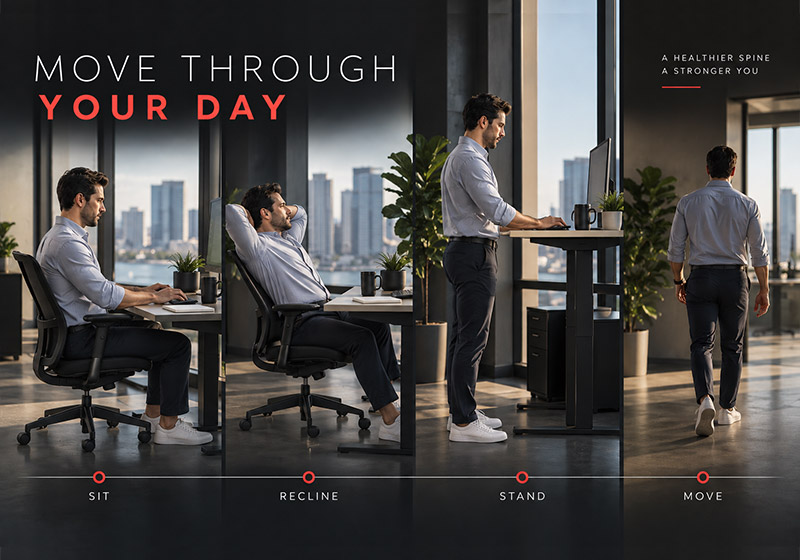
You should be able to lean back sometimes. Sit upright sometimes. Stand sometimes. Get up and walk around. Move your shoulders. Turn your head. Change what your body is doing.
Instead of asking, "What is the perfect posture?" I think a better question is, "How long have I been in this position?"
That changes the conversation completely.
Your Workstation Setup Matters
Saying movement matters doesn't mean workstation ergonomics don't.
If your monitor is dramatically off to one side, you're repeatedly turning your head in the same direction. If your screen is positioned in a way that has you constantly looking down, that changes what you're asking of your neck. If your mouse is too far away, you may spend hours reaching with one arm. If your chair provides no useful support, you may constantly fight to find a comfortable position.
Those things matter.
But I don't want people thinking that spending thousands of dollars on the perfect ergonomic workstation automatically fixes everything.
A $1,500 chair can't move your body for you.
A standing desk doesn't help much if you simply replace eight hours of sitting still with eight hours of standing still.
Ergonomics should make your working environment fit your body better. It shouldn't become an excuse to remain motionless all day.
We'll go much deeper into that distinction later in this Corporate Spine Health series because office ergonomics deserves its own discussion.
Your Laptop Can Make Things More Complicated
Laptops create another problem because the keyboard and screen are attached.
If you position the keyboard comfortably for your hands, the screen may be lower than you'd ideally want it. If you raise the laptop so the screen is closer to eye level, now the keyboard may be uncomfortable to use.
That's a compromise built into the device.
It's particularly relevant for professionals who move between an office, conference rooms, home offices, kitchen counters, airports, hotel rooms, and coffee shops.
You might have a beautifully arranged workstation at your office and then spend three hours that evening looking down at a laptop on your kitchen island.
Your body experiences all of it.
I've discussed the broader structural effects of prolonged screen use in Tech Neck Is Not a Posture Problem. It's Structural. We'll also address laptop-specific neck problems separately in this series because hybrid and remote work have made this an increasingly important part of the conversation.
Then There's Your Phone
The workday doesn't necessarily stop when you step away from your computer.
You walk to lunch while checking your phone.
You answer emails from your phone.
You sit in the car and look at your phone before driving.
You get home and scroll through your phone.
Maybe you answer another work email from the couch later that night.
Individually, none of those moments seems significant. The problem is the accumulation of what your neck and shoulders are being asked to do throughout the entire day.
This is one reason I don't want to evaluate someone's neck pain based solely on a photograph of how they're sitting at their desk. I want to understand the whole pattern.
The Miami Commute Adds Another Layer
For many of my patients from Broward County, the desk is only part of the equation.
They may live in Davie, Plantation, Weston, Sunrise, Pembroke Pines, Cooper City, or Fort Lauderdale and commute into Miami for work. That means the day may begin with an extended period behind the wheel before they ever sit down at their computer.
Then they spend most of the day at a desk.
Then they drive home.
We've already discussed this pattern in The Miami Commute and Your Spine: Why Your Neck and Back Hurt After Driving.
The important point is that your body doesn't separate these activities into different categories just because one happens in your car and another happens in your office.
It's all part of the same day.
If your neck has already been relatively still during your morning commute, followed by hours of computer work and meetings, it shouldn't be surprising if your shoulders feel tight by 4:00 in the afternoon.
Stress Can Show Up in Your Neck and Shoulders Too
There's also a part of this conversation that has nothing to do with where your monitor is positioned.
Stress.
Think about what happens physically when you're under pressure. You may clench your jaw, raise your shoulders, breathe differently, tense your muscles, or sit in one position for longer because you're focused on getting something finished.
Corporate professionals can spend hours moving from deadlines to meetings to phone calls without realizing how much tension they're carrying.
That doesn't mean your neck pain is "just stress."
I don't like that explanation because it can dismiss a legitimate physical problem.
But ignoring stress completely doesn't make sense either. Your workload, sleep, physical activity, workstation, commute, previous injuries, and spinal function can all be part of the bigger picture.
Movement Doesn't Have to Mean a 30-Minute Workout
When I tell patients they need to move more during the workday, some immediately assume I'm asking them to block out half an hour for exercise.
I'm not.
Sometimes the most realistic changes are the simplest ones.
Stand up while you're on a phone call. Walk to refill your water. Get up between meetings. Change where you're sitting. Move your shoulders through a comfortable range. Take a short walk at lunch instead of eating every meal at your desk.
Recent research is actually encouraging here. A 2026 systematic review and meta-analysis of 19 studies involving 2,732 sedentary workers found that brief workplace "micro-exercises" reduced neck and shoulder pain, although the certainty of the evidence varied and some of the results showed substantial differences between studies.
The takeaway isn't that everyone needs to perform one specific exercise every 27 minutes.
It's that small amounts of movement throughout the workday can matter.
What About Strength Training?
This is another area where the research is interesting.
Strengthening the neck, shoulder, and surrounding musculature has shown benefits for office workers who already have chronic neck pain. A 2024 systematic review found reductions in neck pain and disability following strengthening exercises, although the authors rated the overall certainty of the evidence as low. An earlier systematic review also found clinically meaningful pain reduction favoring strengthening exercise over no exercise.
That's useful information, but I wouldn't turn it into the claim that everyone with a tight neck simply needs stronger muscles.
Again, we're dealing with individuals.
Someone may benefit from strengthening. Someone else may have an underlying problem that needs to be evaluated. Another person may primarily need to change how they're structuring their workday.
The research helps guide the conversation. It doesn't replace examining the patient.
When "Tightness" Becomes Something You Should Pay Attention To
A little stiffness after an unusually long day at the computer is one thing. Feeling the same neck and shoulder tension every afternoon for six months is different.
I pay attention when patients tell me they constantly need to crack or stretch their neck, massage their shoulders, take medication, use a heating pad every night, or change positions every few minutes because they can't get comfortable.
I also want to know whether there are symptoms beyond tightness. Are you developing headaches? Does pain travel into the shoulder blade or arm? Are you experiencing numbness, tingling, or weakness? Does your neck interfere with sleep? Are you avoiding exercise or activities you normally enjoy?
Those details matter.
Your body doesn't send you a written explanation telling you exactly what's wrong. It gives you symptoms.
If those symptoms keep returning, it's worth figuring out why.
How I Look at Desk-Related Neck Pain
When someone comes into my Davie office and tells me, "My neck hurts because I sit at a computer all day," I don't automatically accept the computer as the diagnosis.
That's the environment.
Now I need to evaluate the person.
I want to know how long the problem has been happening, where they feel it, whether it's getting worse, what their workday looks like, whether symptoms change on weekends, how much they exercise, what their commute looks like, and whether there have been previous injuries.
Then I examine how their spine is functioning.
When clinically appropriate, X-rays may provide additional information about spinal structure, alignment, degeneration, and other factors that aren't visible from simply watching someone sit at a computer. I've explained in more detail why chiropractors take X-rays and what I'm looking for when imaging is appropriate.
That's why the goal isn't just to tell someone to raise their monitor two inches and send them home.
I want to understand why this particular person is having this particular problem.
You Still Have to Work
I'm realistic about this.
If you're an attorney, executive, accountant, engineer, manager, business owner, programmer, or anyone else whose career requires substantial computer time, I'm not going to tell you to stop using a computer.
That's not useful advice.
We need to figure out how to make your body more capable of handling the life you actually live.
That may involve changing parts of your workstation. It may involve moving more frequently. Exercise may be part of the answer. Your commute may need to be considered. And if there's an underlying spinal problem contributing to recurring symptoms, that needs to be evaluated rather than continually covered up.
The goal isn't to create a perfect workday.
It's to stop accepting daily neck and shoulder pain as an unavoidable requirement of having a desk job.
Frequently Asked Questions
Spending long periods working at a desk can be associated with neck pain, particularly when prolonged computer use is combined with repetitive tasks, limited movement, workstation demands, and other individual factors.
But I wouldn't automatically say sitting itself is the sole cause.
Neck pain is usually more complicated than that. Two people can work at similar desks for the same amount of time and have completely different experiences. That's why recurring symptoms should be evaluated in the context of the whole person rather than blamed on one chair or one posture.
Computer work can require your neck, shoulders, arms, and upper back to maintain relatively low-level activity for long periods. You may also gradually reach forward, elevate your shoulders, or change your head position as you concentrate.
Add hours of mouse use, typing, meetings, phone use, and limited movement, and it's easy to understand why some people begin feeling tight by the afternoon.
The question becomes more important when that tightness happens every day or starts progressing into pain, headaches, arm symptoms, or other problems.
I don't believe there is one posture you should force yourself to maintain for eight hours.
A comfortable, well-supported workstation is important. Your monitor, chair, keyboard, and mouse should be positioned so you aren't unnecessarily reaching, twisting, or straining to work.
But even a good position benefits from variation.
Sit. Stand. Move. Walk. Change positions.
Instead of obsessing over perfect posture, pay attention to how long you've remained in the same posture.
Not necessarily.
A standing desk can be a useful tool because it gives you another working position. But standing in essentially the same position for eight hours isn't automatically better than sitting for eight hours.
I prefer using a sit-stand desk as a way to create variation throughout the day rather than treating standing as the "correct" posture and sitting as the "wrong" one.
And if neck pain keeps returning regardless of your desk setup, it's worth looking beyond the furniture.
Research suggests that exercise, particularly strengthening exercises involving the neck, shoulders, and shoulder-blade musculature, may reduce pain and disability in office workers with chronic neck pain. However, the quality and certainty of the evidence varies, so exercise shouldn't be presented as a universal cure.
I strongly believe in movement and exercise, but the right approach depends on the person. If you're dealing with persistent pain or neurological symptoms, I would rather evaluate what's happening before assuming you simply need to exercise more.
If your neck occasionally feels stiff after an unusually demanding day and quickly returns to normal, that's different from a problem that appears every day.
I'd pay closer attention if symptoms are becoming more frequent, worsening, affecting sleep, interfering with exercise, or requiring constant stretching or medication to stay comfortable.
Pain traveling into an arm, numbness, tingling, weakness, severe or unusual headaches, significant dizziness, or other neurological symptoms also deserve appropriate medical evaluation.
Your Desk Job Doesn't Have to Mean Daily Neck Pain
Working at a desk is part of modern life for millions of people, and for many South Florida professionals, it's how they earn their living. I'm not interested in telling someone in Davie, Weston, Plantation, or Pembroke Pines that the solution to their neck pain is to stop working at a computer.
I am interested in understanding why their body is struggling with the demands of that work.
Your workstation matters. Your movement matters. Your exercise habits matter. Your commute, stress, previous injuries, sleep, and spinal function may matter too. The mistake is reducing the entire problem to "bad posture" and assuming a new chair will fix everything.
If you're spending your workday constantly rubbing your neck, rolling your shoulders, stretching, or waiting until you can finally get away from your desk, pay attention to that pattern.
If it keeps happening, let's figure out why.
My chiropractic office in Davie is convenient for many patients who work throughout South Florida but live in Broward County. We'll evaluate what's actually going on and determine what makes sense for you.
Your career may require a desk. It shouldn't require you to be uncomfortable every day.
About the Author:
Dr. Zev Mellman is a licensed chiropractor serving patients throughout South Florida and beyond. His practice focuses on spinal health, mechanical causes of pain, and conservative approaches to musculoskeletal care.
- Licensed Doctor of Chiropractic in the State of Florida
- Florida License Number: CH9524
- License Original Issue Date: 01/15/2008